
From Skills to Impact: How We Help Interpreters Build Meaningful Careers
At The Interpreter’s Lab, we design our courses with adults in mind – adults with busy schedules, other studies, family obligations, and those transitioning into or out of careers.
Our courses are short and intensive, yet they cover all the essential principles necessary for professional interpreter training. We emphasize blended learning, live sessions, passionate and experienced instructors, quizzes, robust final exams, and meaningful assignments. Our top priority is ensuring students understand both the importance and the responsibility of the interpreter role, particularly in public service and community settings. Interpreters engage directly with the real-life activities of others, which requires specific competencies to fulfill the role effectively. We also focus on self-awareness – helping students recognize areas where they might need improvement and providing tools and strategies to proactively enhance their professional skills.
We equip our students with tools both during the course and for their ongoing development. In fact, we explicitly tell them: “This is your toolbox – filled with the tools you need to do the job today and to do it even better tomorrow.”
A core component of our foundational course, Interpreting in Community Settings, is a practical research assignment called Researching the Landscape. This course teaches the fundamentals: the interpreter’s role, principles, ethics, competencies, skills, techniques, and public service protocols. The research assignment challenges students to identify where interpreters work by guiding them through a set of 15 questions designed to promote effective inquiry. They explore search engines, keywords, and online research methods while paying attention to the quality of their findings.
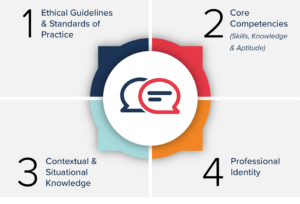
This is your toolbox – filled with the tools you need to do the job today and to do it even better tomorrow.
A comment I often hear from new students is: “I never realized what a far-reaching and professionally-defined occupation this is”. It’s true – interpreting plays a critical role in access, inclusion, and service efficiency, yet it remains almost invisible to the public. This lack of visibility stems partly from the fact that, in a multilingual society like Canada, bilingualism is often taken for granted. Many assume that speaking two languages equates to effective communication, message conversion, and a full understanding of how to respect the voices and intentions of speakers. The reality, however, is that interpreting is a highly specialized and often hidden profession.
Through the Researching the Landscape activity, students discover a wide range of places where interpreters work. Some findings hit the mark, while others miss – but the learning process is invaluable. They come to understand the concept of working through agencies, ex[;pre what a language service provider (LSP) is, and begin to grasp that pursuing a career in interpreting involves more than language skills. It requires contract negotiation, professional networking, organizational skills, and the mindset of a freelance professional.
This assignment is one of my personal favourites. After covering lessons on the interpreter’s role, comprehension, breaking down competencies, memory skills, note-taking, sight translation, ethics, and Standards of Practice, we arrive at the final session: the practical realities of working as an interpreter. This focus on professional preparedness sets our program apart. We don’t just teach skills – we empower our students to transform those skills and newfound confidence into real careers. We help them understand growth pathways, think beyond their immediate communities, and appreciate the broad scope and impact of interpreting.
Learn more about our programs: www.interpreterslab.org
Read what is covered in the Interpreting in Community Settings – A Foundational Program