Interpreter Training Is Not Content Delivery

Workshops, Techniques and the Hard Truth About Interpreter Training

There are tips and techniques.

There are workshops, webinars, and quick fixes.

And then there is training.

These things are not the same. Treating them as interchangeable has quietly undermined the interpreting profession for years.

Workshops have value. They raise awareness, introduce ideas, and support interpreters who already have a foundation. But they do not replace training.

Training is structured, cumulative, and grounded in standards. It is what moves someone from being bilingual to being appropriately qualified. That distinction matters, whether people realize it or not, especially in situations where the consequences are real and the impacts are lasting.

The Work Behind the Words

One of the most persistent myths in our field is that interpreting is simply “helping out” with language; that if you speak two languages and care enough, a few workshops will prepare you.

This belief is usually rooted in goodwill. Communities want access. Organizations are under pressure. People step in because someone must. But good intentions do not equal professional competence.

When interpreting is reduced to the act of speaking two languages, the work is treated as a simple transaction: words in, words out. But that framing oversimplifies the complex process of communicating across languages, cultures, and people. Interpreting involves constant decision-making within complex human and institutional contexts.

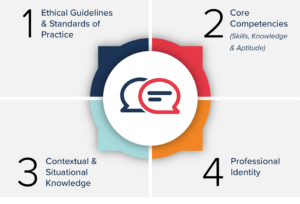
Interpreting requires far more than bilingual ability; it includes, among other important things, ethical judgment, role clarity, session management, discourse and register control, memory, and research skills.

Those competencies don’t emerge accidentally. They are developed deliberately and progressively.

“Interpreting is not a transaction. It is a professional, decision-based practice.”

Learning About Interpreting vs. Learning to Be an Interpreter

This is where confusion often arises.

Workshops tend to focus on content:

  • What interpreters do
  • Common mistakes
  • Ethical scenarios
  • Practical tips

Training focuses on formation:

  • Exploring communication
  • Meaning and language
  • Professional identity
  • Scope of practice
  • Decision-making and critical thinking
  • Developing professional competencies and skills
  • Accountability to standards
  • Consistency across settings
  • Ethical awareness and dilemma resolution

A webinar can raise awareness. A workshop can spark insight. But neither prepares someone to interpret in public service settings such as social services, healthcare, law enforcement, or mental-health contexts, where the consequences are real.

“Training is not about shortcuts. It is about readiness.”

Where Asynchronous Learning Fits–and Where It Doesn’t

Asynchronous learning, self-paced learning that occurs without live, real-time interaction between instructors and learners, has a role in interpreter education. It can support foundational knowledge, introduce concepts, and allow learners to engage with theory, terminology, and ethical frameworks at their own pace.

What it cannot do, on its own, is develop skilled interpreting competence. Asynchronous learning can support training, but it cannot replace it.

Interpreting is a performative, decision-based practice. It requires real-time interaction, guided feedback, correction, and exposure to unpredictability. These elements cannot be meaningfully replicated through fully self-directed, asynchronous formats. Without structured interaction and feedback, learners may absorb information without developing judgment.

When asynchronous learning is positioned as a complete substitute for interpreter training, it creates the illusion of readiness without the conditions needed to develop it.

And while the growth of asynchronous and on-demand learning has made education more accessible, that accessibility is not the same as adequacy. When it comes to acquiring tangible interpreting competencies, asynchronous learning alone is not innovation. It is omission.

Why Standards Matter, Especially When No One Is Enforcing Them

In many jurisdictions, including Canada, interpreter training is uneven or unregulated. That vacuum allows almost anything to be labelled “training.”

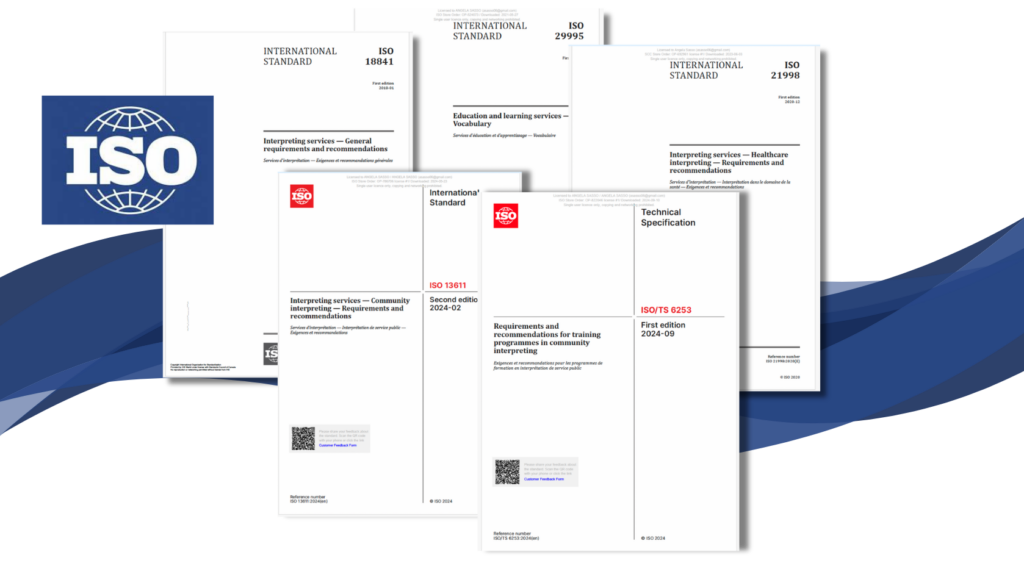
This is precisely why standards matter. International frameworks such as ISO 13611:2024 Interpreting services — Community interpreting — Requirements and recommendations and ISO/TS 6253:2024 Requirements and recommendations for training programmes in community interpreting articulate what professional practice and interpreter education require: defined learning outcomes, qualified educators, structured programmes, assessment, and progression.

Even when training programs are short in duration, they are designed to build competence, not simply share tips and tricks. 

At The Interpreter’s Lab (TIL), our courses are built around these principles, not to be prescriptive, but to be responsible. Without standards, training becomes performative rather than transformative.

Real-World Training for a Real-World Landscape

Our courses may not be the longest, and that is intentional.

Our programmes are largely self-funded by participants, so accessibility matters. We design our courses to be focused and rigorous, without unnecessary length or cost. At the same time, we are responding to urgent workforce needs and systems that too often rely on “good enough” language support. Shorter does not mean lighter.

At a time when interpreter training programmes have been closing across Canada, we have remained relevant by staying current. Our programmes are intentionally designed to sit at the intersection of academia and industry; grounded in professional practice and informed by the real-world realities interpreters are navigating now, not an abstract or idealized version of the profession.

“Accessibility in education is important, but accessibility is not the same as adequacy.”

This includes engaging with current modes of practice, evolving technologies, and the practical skills interpreters need to sustain their work, such as finding assignments, negotiating contracts and fees, and adapting to new forms of service delivery.

Rather than treating these realities as peripheral, we embed them into training as part of professional formation, alongside ethical judgment, international standards, and reflective practice.

Our programmes are taught by experienced practitioners and educators who have spent years working in, advocating for, and shaping this field; they are designed to lay a strong professional foundation.

Training does not need to be endless to be rigorous. It needs to be coherent, intentional, and accountable; it must provide a solid foundation for ongoing professional development, guided by those who understand both the field and the work.

From “Bilingual Helper” to Professional Practitioner

Many bilingual individuals have been interpreting for years before encountering formal training. When they do, the realization can be uncomfortable: there is much more to this profession than they were ever told.

That moment is not failure. It is professional awakening. As the saying goes, you don’t know what you don’t know.

Proper training reframes the role. It moves interpreters away from instinct-driven decisions and blurred boundaries, and toward ethical clarity, professional confidence, and consistency.

Training Is a Beginning, Not a Badge

Completing a solid training programme does not make someone “finished.” It provides a foundation, one that supports specialization, mentorship, and continuing professional development.

That is how professions function.

Tips have their place. Workshops have value.

But training, real training, is what turns intention into competence.

And once that distinction is clear, it’s impossible to ignore.

References and Resources

ISO STANDARDS ISO 37/SC 5

ISO 13611:2024

ISO/TS 6253:2024

Claudio Fantinuoli:

  1. Panel: The Future of Interpreter Training: Challenges, AI, and the Path Forward https://www.claudiofantinuoli.org/2025/02/28/the-future-of-interpreter-training-challenges-ai-and-the-path-forward/
  2. What future for translation and interpreting training institutions? https://www.claudiofantinuoli.org/2025/01/25/what-future-for-translation-and-interpreting-training-institutions/


Deep Impacts: 2025 Highlights at The Interpreter’s Lab

2025 was a year of deepening impact, strengthening training, advancing standards, and building stronger bridges between interpreters, institutions, and communities.

At TIL, we continue to advocate at all levels for the important contributions of interpreters and for recognition of interpreting as a specialized profession. The work that we do and the initiatives supported interpreters across spoken and signed languages nationwide. In 2025 over 150 new and practicing interpreters engaged in our training and continuing education programs. Building on current research and established best practices endorsed by international experts, TIL regularly strengthens its core curriculum and foundational ethical guidelines for interpreters.

Check out this Blog for More Information on How TIL Sets the Pace

Programs continued to align with Canadian and international standards while remaining grounded in real-world practice.

Learning & Professional Development (Membership Program)

Professional Development and Continuing Education

Interpreting in Law Enforcement – Working with the Police – Masterclass with Dr. Debra Russell (offered again in 2026)

  • 2 sessions for ASL interpreters
  • 1 session for spoken-language interpreters

Four cohorts of Interpreting in Community Settings – A Foundational Program

Interpreting in Legal & Court Settings

  • 1 cohort for spoken-language interpreters
  • 1 cohort for ASL–English interpreters, adapted from our long-standing spoken-language curriculum to meet the specific requirements of ASL–English interpreting.

Program & Curriculum Development

  • Implemented ISO/TS 6253:2024 across programs, supported by a successful full internal audit.

Updated course content across programs, including:

  • Revised Ethical Guidelines for Interpreters in Community Settings
  • Updated competency frameworks and assessment measures
  • Engaged a new instructor with expertise in training for interpreting in Indigenous languages 

Partnerships & Customized Training

  • Designed and delivered a customized training program for the Family Support Institute of BC (Resource Parent / Peer Programs)
  • Welcomed new partner agencies into our organizational training programs
  • Strengthened collaboration with professional membership organizations in Canada and internationally

Sector Leadership & Standards

Continued service as:

  • Board Member and Chair, Interpreting Committee – Canadian Language Industry Association (CLIA)
  • Certified Member, Women Business Enterprises (WBE)
  • Presentation to Canadian Translators, Terminologist and Interpreters Council Board at their annual AGM on ISO TC 37/SC 5 projects and standards
  • Ongoing leadership in the rollout and implementation of international standards in interpreter education
  • Initiated the BC Working Group on Interpreting Services, in collaboration with the Provincial Language Service (PHSA BC), a cross-sectoral initiative exploring system-level improvements to access and information on qualified language services.

Presentations & Advocacy

  • Speech-Hearing BC: Enhancing Speech-Language Pathology Practices: Strategies for Effective Collaboration with Interpreters
  • Health Standards Organization (HSO): Language Access as the Tipping Point for Equity and Inclusion
  • PSIT Networking Group – UK – London Metropolitan University (June 13); The Canadian Experience in Public Service Interpreting
  • Met with Minister Niki Sharma, BC Attorney General, to discuss language access, interpreting, procurement practices, and ISO standards.

Media & Knowledge Sharing

Excellence as Standard Practice

2025 was an exceptional year for The Interpreter’s Lab, marked by meaningful growth, collaboration, and impact. As always, we continue to evolve our programs, strengthen standards-aligned training, and respond to emerging needs in the field.

This progress is only possible through the trust and engagement of our members, partners, and collaborators. We look forward to building on this momentum together in 2026.

AI and Interpreting: What You Need to Know

This year at The Interpreter’s Lab, we’ve been digging deeper into AI, just as many others in the interpreting field have.

Interpreting in community and public service settings, whether in education, healthcare, or law enforcement, is uniquely complex. It’s not only about managing dynamic, interpersonal communication but also about working across many languages and navigating truly localized knowledge. Accuracy matters profoundly when people’s health, safety, or liberty are on the line. That means community interpreters must approach AI with caution.

Still, when used wisely, these tools can serve a valuable purpose.

“AI is not here to replace interpreters – and won’t be for the foreseeable future.”

From note-taking apps to terminology management, there are countless AI tools that can support interpreters before and after assignments. But when it comes to community interpreting, things get more complicated. Unlike conference interpreters who may work with teams, booths, and on-site technology support, community interpreters often work alone. They are expected to respond in the moment with critical decision-making skills rooted in professional confidence and ethical understanding. Confidentiality and client privacy are central, meaning that pulling out a phone or laptop mid-session to run an AI tool usually isn’t an option.

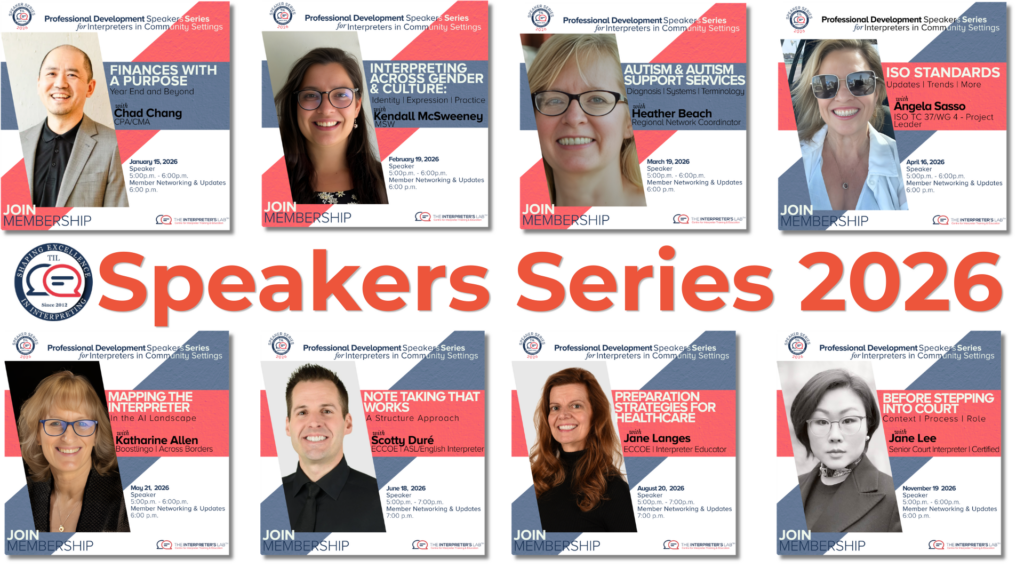
This doesn’t mean AI is off the table. As we learned recently at the August session of The Interpreter’s Lab Speakers Series Professional Development with Evelyn Cervantes, there are creative and ethical ways to bring AI into your professional toolkit.

Practical Ways Interpreters Working in Community and Public Sector Services Can Use AI

  1. Pre-Session Preparation
    AI tools can help interpreters research terminology, generate practice scenarios, or organize glossaries before an assignment. Some tools even allow you to upload documents or background material (with privacy considerations in mind) to get a clear sense of key concepts.
  2. Post-Session Reflection
    After assignments, AI can support with debriefing and self-study. Summarization tools, for instance, can help you review notes and identify areas where additional terminology practice is needed. As any good interpreter knows, a reflective practice is a professional practice.
  3. Practice Management
    No matter how powerful the tool, the responsibility for managing and organizing your practice remains yours. AI can generate resources, but it won’t tell you how to structure your files, prioritize your workload, or balance your commitments. That’s where your professional judgment comes in.

What to Watch Out For:
AI isn’t perfect, and interpreters need to approach it critically:

  • Accuracy and Reliability: Just because AI provides a reference doesn’t mean it’s correct, or even real. Always verify.
  • Privacy Concerns: Free versions of tools may not protect your data. Be cautious about uploading sensitive materials, especially anything linked to client information.
  • Free vs. Paid Subscriptions: Paid tools often provide better security, features, and accuracy. But even then, due diligence is essential.

Why This Matters
AI is not here to replace interpreters – and won’t be for the foreseeable future.  Instead, it can complement our skills and make us more efficient, better prepared, and more reflective practitioners, if used wisely. In community interpreting, where confidentiality, ethics, and quick thinking are paramount, the key is knowing when and how to integrate these tools without compromising professional standards.

As AI continues to evolve, so too will the conversations about how interpreters can, and should, engage with it. At The Interpreter’s Lab, we believe that staying informed and critically reflective is part of what makes a strong professional community. That’s why our monthly Pro-D sessions don’t just introduce tools, but also create space to explore the ethical, practical, and real-world implications for community interpreters – technology is only as useful as the ethical framework we bring to it.

AI isn’t a replacement for professional skill, judgment, or standards, but it can be a supportive ally when approached wisely. We invite you to join us as we continue to explore these questions together.

Not yet a member of The Interpreter’s Lab?

Join today to access our monthly Pro-D sessions, practical tools, and supportive community of interpreters. Learn more here


2025 Annual Masterclass Interpreting in Law Enforcement Settings with Dr. Debra Russell

About the 2025 Masterclass

Interpreting in Law Enforcement Settings with Dr. Debra Russell

This Masterclass will centre on best practices for interpreters working with law enforcement agencies, with a particular focus on interpreting for the police.

It is designed to teach interpreters the practical skills and knowledge required to work effectively in police settings while understanding the Canadian legal context.

Workshop Overview

This specialized Masterclass is designed for interpreters working in legal, court and community settings who want to deepen their skills in law enforcement interpreting. With a focus on real-world application, participants will engage in hands-on activities using police transcripts and case studies.

Led by Dr. Debra Russell, this interactive session includes role-play exercises that will challenge and refine participants’ ability to accurately interpret complex, emotionally charged, and sensitive communications between civilians and law enforcement personnel. Ethical dilemmas, professional boundaries, and the consequences of interpreter errors will also be explored, equipping interpreters with practical strategies to manage dynamic situations.

Participants will leave the workshop with a greater understanding of the protocols, expectations, and pressures unique to interpreting in policing contexts—and the confidence to perform their roles with accuracy and professionalism.

Participants will learn to:

  • Be better prepared to handle the demands of interpreting in law enforcement settings.
  • Communicate effectively with police personnel and navigate law enforcement structures.
  • Address ethical dilemmas with clarity and confidence.
  • Apply interpreting strategies that uphold standards in legal contexts.
  • Understand the real-world consequences of interpreter errors—and how to avoid them.
  • Reflect on personal positioning and neutrality in adversarial or emotionally intense environments.

Pricing

TIL Members: $25 + GST

Non-members: $85 + GST

PDU’s/ CEU’s: 3 (CTTIC & Partners)

Interpreting in Healthcare and Medical Settings

Interpreting in Healthcare & Medical Settings
Specialized Interpreter Training Program

Gain the specialized skills and knowledge you need to succeed as a medical interpreter.

Interpreting in healthcare settings is complex, demanding, and deeply impactful. This course prepares you to work confidently alongside general practitioners, nurses, surgeons, specialists, and other health professionals—both in-person and remotely.

  • Required for entry into our advanced Mental Health & Complex Settings program
  • Helps prepare for the CTTIC Medical Interpreter Certification Exam
  • Taught by expert Canadian Certified Medical Interpreters with 20+ years of experience

What to Expect:

  • Interactive role plays and case studies

  • Live discussions and simulation activities

  • Student manual, curated resources, and support

Prerequisite:
Completion of the Community Settings Foundational Training Program is required before enrolling.

REGISTER HERE OR BY SELECTING THE LINK ON THE LEFT

Have questions before you register? Sign up for a FREE INFORMATION SESSION. And get all your questions answered before you sign up. 

Progress or Perish: In a World of Constant Change, Shouldn’t Education Keep Up?

Dr. Claudio Fantinuoli recently argued in an article for the Chartered Institute of Linguists that translation and interpreting education must evolve or risk becoming irrelevant—a point I’ve been making for years. While his focus is likely on conference interpreting curricula and simultaneous mode training, the same—or even greater—urgency applies to community and public-service interpreting, whether simultaneous, consecutive, remote, or in-person.

“It should be quite clear that if we continue along the current trajectory of absence of relevant change, we risk drifting into irrelevance—and this could happen sooner than expected.”

Interpreter Training Must Keep Pace

Public service and community interpreter training in Canada can be traced back to the 1970s, when one of the country’s most robust programs launched in Vancouver, British Columbia. Although other programs followed over the years, most ceased updating their content by the early 2010s. Since then, the profession’s demands, core competencies, ethical guidelines, and standards of practice have shifted dramatically. It’s understandable that many institution-based programs lack the flexibility to adapt—perhaps explaining their decline or demise—but remaining anchored in outdated theories and practices renders their course content irrelevant, and that’s before even considering the profound impact of AI and other emerging technologies.

When curricula ignore modern tools, platforms, and workflows, interpreters miss the chance to learn how to use these innovations effectively—and are left unable to discuss them knowledgeably with clients, further widening the gap between practice and consumer needs.
Of course, a firm grounding in the profession’s foundations—its ethics, principles, and theoretical frameworks—is essential. But training must also meet the expectations of the 21st-century marketplace, equipping students to handle contemporary challenges from day one.

Interpreter Education Through a Real-World Lens

That forward-looking perspective motivated me to spearhead ISO TS 6253:2024, Requirements and recommendations for training programmes in community interpreting. This first ISO publication to address interpreter training in specialized settings marks a significant milestone in the evolution of public-service language services—one I was proud to champion and privileged to lead as project head of the international working group. And because progress is essential to sustain relevance in both education and standards, we’re already revisiting the specification to make it even more accessible and aligned with today’s needs.

Progress Means Letting Go

We need to let go of outdated paradigms and frameworks so that the essential role of interpreting—and interpreters themselves—is genuinely understood and valued. Interpreter education must be dynamic, responsive, and grounded in best ethical practices. Anything less does a disservice to our students and to the broader field of community interpreting. Training programs must be agile and innovative, actively engaging with the marketplace. Change may be difficult, but irrelevance is far worse.

“Let’s not ever forget that amid these challenges lie opportunities. Beyond boldly reforming existing structures – which is admittedly difficult –there is also the possibility of creating something entirely new. Perhaps a new type of institution is needed – one that anticipates future changes rather than merely reacts to them.”

End Note:
I would like to thank Dr. Fantuoli’s for his contributions to our understanding, and I encourage you to read his particular article (linked below) as many very good and insightful points are made.
All quoted content – Claudio Fantinuoli PhD in CIOL (Chartered Institute of Linguists)
https://www.ciol.org.uk/future-translation-interpreting-training?utm_source=pocket_shared

What’s in the Interpreter’s Toolbox?

From Skills to Impact: How We Help Interpreters Build Meaningful Careers

At The Interpreter’s Lab, we design our courses with adults in mind – adults with busy schedules, other studies, family obligations, and those transitioning into or out of careers.

Our courses are short and intensive, yet they cover all the essential principles necessary for professional interpreter training. We emphasize blended learning, live sessions, passionate and experienced instructors, quizzes, robust final exams, and meaningful assignments. Our top priority is ensuring students understand both the importance and the responsibility of the interpreter role, particularly in public service and community settings. Interpreters engage directly with the real-life activities of others, which requires specific competencies to fulfill the role effectively. We also focus on self-awareness – helping students recognize areas where they might need improvement and providing tools and strategies to proactively enhance their professional skills.

We equip our students with tools both during the course and for their ongoing development. In fact, we explicitly tell them: “This is your toolbox – filled with the tools you need to do the job today and to do it even better tomorrow.”

A core component of our foundational course, Interpreting in Community Settings, is a practical research assignment called Researching the Landscape. This course teaches the fundamentals: the interpreter’s role, principles, ethics, competencies, skills, techniques, and public service protocols. The research assignment challenges students to identify where interpreters work by guiding them through a set of 15 questions designed to promote effective inquiry. They explore search engines, keywords, and online research methods while paying attention to the quality of their findings.

This is your toolbox – filled with the tools you need to do the job today and to do it even better tomorrow.

A comment I often hear from new students is: “I never realized what a far-reaching and professionally-defined occupation this is”. It’s true – interpreting plays a critical role in access, inclusion, and service efficiency, yet it remains almost invisible to the public. This lack of visibility stems partly from the fact that, in a multilingual society like Canada, bilingualism is often taken for granted. Many assume that speaking two languages equates to effective communication, message conversion, and a full understanding of how to respect the voices and intentions of speakers. The reality, however, is that interpreting is a highly specialized and often hidden profession.

Through the Researching the Landscape activity, students discover a wide range of places where interpreters work. Some findings hit the mark, while others miss – but the learning process is invaluable. They come to understand the concept of working through agencies, ex[;pre what a language service provider (LSP) is, and begin to grasp that pursuing a career in interpreting involves more than language skills. It requires contract negotiation, professional networking, organizational skills, and the mindset of a freelance professional.

This assignment is one of my personal favourites. After covering lessons on the interpreter’s role, comprehension, breaking down competencies, memory skills, note-taking, sight translation, ethics, and Standards of Practice, we arrive at the final session: the practical realities of working as an interpreter. This focus on professional preparedness sets our program apart. We don’t just teach skills – we empower our students to transform those skills and newfound confidence into real careers. We help them understand growth pathways, think beyond their immediate communities, and appreciate the broad scope and impact of interpreting.

Learn more about our programs: www.interpreterslab.org

Read what is covered in the Interpreting in Community Settings – A Foundational Program