

Interpreting is everywhere. You encounter interpreters in hospitals, courtrooms, community centres, schools, at the insurance office, during financial aid meetings, or in child welfare visits, and even at the negotiating table when organizations or communities need to find common ground across a language divide. And yet, despite its reach and its stakes, the profession remains poorly understood by most people, including many who are drawn to it.
At The Interpreters Lab, we hear the same question regularly: How does someone actually become an interpreter? It is one of the most searched and least clearly answered questions in the field. The pathway is not as linear as medicine or law, and there is no single credentialing body that defines it universally. That ambiguity can be discouraging, but it shouldn’t be. The path exists. It is well-established, and for the right person, it is deeply rewarding.
This is where it starts.
Language Proficiency: The Non-Negotiable Foundation
Every conversation about interpreter training must begin here, because there is no version of this profession that does not require it. Genuine, high-level proficiency in at least two languages is not a preferred qualification, it is a baseline requirement. And it is worth being precise about what proficiency means in this context.
The interpreter is not a translator working quietly at a desk with time to consult a dictionary. The interpreter operates in real time, in live environments, often under significant pressure. They must receive meaning in one language and render it accurately, completely, and fluently in another, in consecutive or simultaneous mode and within moments. That demands more than academic knowledge of a language. It demands the kind of fluency that is intuitive, flexible, and responsive to register, dialect, emotional tone, and context.
If you are bilingual and considering this career, ask yourself honestly: in both of your languages, can you follow rapid, idiomatic speech without effort? Can you express complex ideas with precision? Can you shift register fluidly, from formal to colloquial; from clinical to conversational; without losing accuracy? These are the standards the profession demands. This is what training teaches you.
The Personal Qualities That Drive the Work
Language proficiency is necessary, but it is not all. This is where many aspiring interpreters are surprised.
The weight of that responsibility is real. For the professionals who carry it well, it is also the most compelling reason they chose the field.
The qualities that distinguish a skilled interpreter are not only linguistic. They are fundamentally human. A genuine interest in people, in their circumstances, their communication styles, their cultural frameworks, is not a nice-to-have. It shapes how an interpreter shows up in a room. So does intellectual curiosity, a comfort with uncertainty, and the capacity to remain composed and focused in environments that are often emotionally charged or logistically demanding.
Interpreters in community or public services often work in settings defined as complicated and complex. They encounter people at their most vulnerable, their most adversarial, and their most exposed. The professionals who thrive in this work tend to share a particular disposition: they are drawn to the challenge rather than deterred by it.
Not sure whether you have the profile? Our assessment was designed to help you find out. Take the Do You Have What It Takes Assessment
Foundational Training: Where the Talent Meets Competence

The assumption that bilingualism alone qualifies someone to interpret professionally is one of the most persistent and consequential misconceptions in the field. Foundational training is not supplementary. It is essential. It is where interpreting as a discipline is actually learned.
Structured training – such as The Interpreter’s Lab Interpreting in Community Settings course – introduces the core modes of interpreting:
- consecutive interpreting, in which the interpreter renders a complete utterance after the speaker pauses
- simultaneous interpreting, in which the interpreter works in real time, with almost no delay
- sight translation, in which the interpreter reads from a document in one language and translates it into another – using either spoken or signed.
Each mode requires distinct skills and significant practice to execute well. Training also covers:
- note-taking methodology
- memory retention techniques
- research skills
- ethics
- cognitive strategies (necessary to manage the considerable mental load of live interpreting)
Equally important is the professional formation that takes place in a rigorous training environment:
- understanding the interpreter’s role and its limits
- developing the discipline of impartiality
- learning to navigate the ethical dimensions of the work (before encountering them in the field)
But in Canada, these pathways are limited in both availability and relevance. Where they do exist, they are often tied to official languages and follow highly structured academic routes. For many of the languages used in community settings, these pathways are not only unavailable, they often don’t align with the realities of the work.
Canada’s linguistic landscape tells a different story. According to the 2021 Census, the most common mother tongues other than English or French include Mandarin, Punjabi, Cantonese, and Spanish. Beyond these, more than 100,000 people each speak Arabic, Tagalog, Persian/Farsi, Urdu, Russian, and Korean at home.
Punjabi, Mandarin and Arabic Languages in Demand
The demand for community interpreters in languages such as Punjabi, Mandarin, Arabic, Tagalog, Hindi, Urdu, and Farsi is not only substantial, it is actively growing. And importantly, this demand is not uniform across the country. Regional variation matters. In British Columbia, Mandarin and Punjabi are among the most commonly spoken languages; in Ontario, Punjabi and Arabic are prominent; and in Quebec, Arabic is the most common immigrant language.
In other words, the need for interpreting spans a wide and evolving range of languages, shaped by local realities. Yet the training pathways have not kept pace. What exists on paper does not always reflect what is needed in practice.
For most languages outside of signed languages and Canada’s official languages, formal educational pathways are limited. Where they do exist, they are often found in private training models or smaller, practice-based programs rather than within traditional academic institutions.
That said, pathways into foundational training do exist. These may include university programs in conference interpreting or translation studies, community and healthcare interpreter certification programs, and specialized training institutes. The appropriate pathway depends on the individual’s goals, prior education, and the settings in which they intend to work.
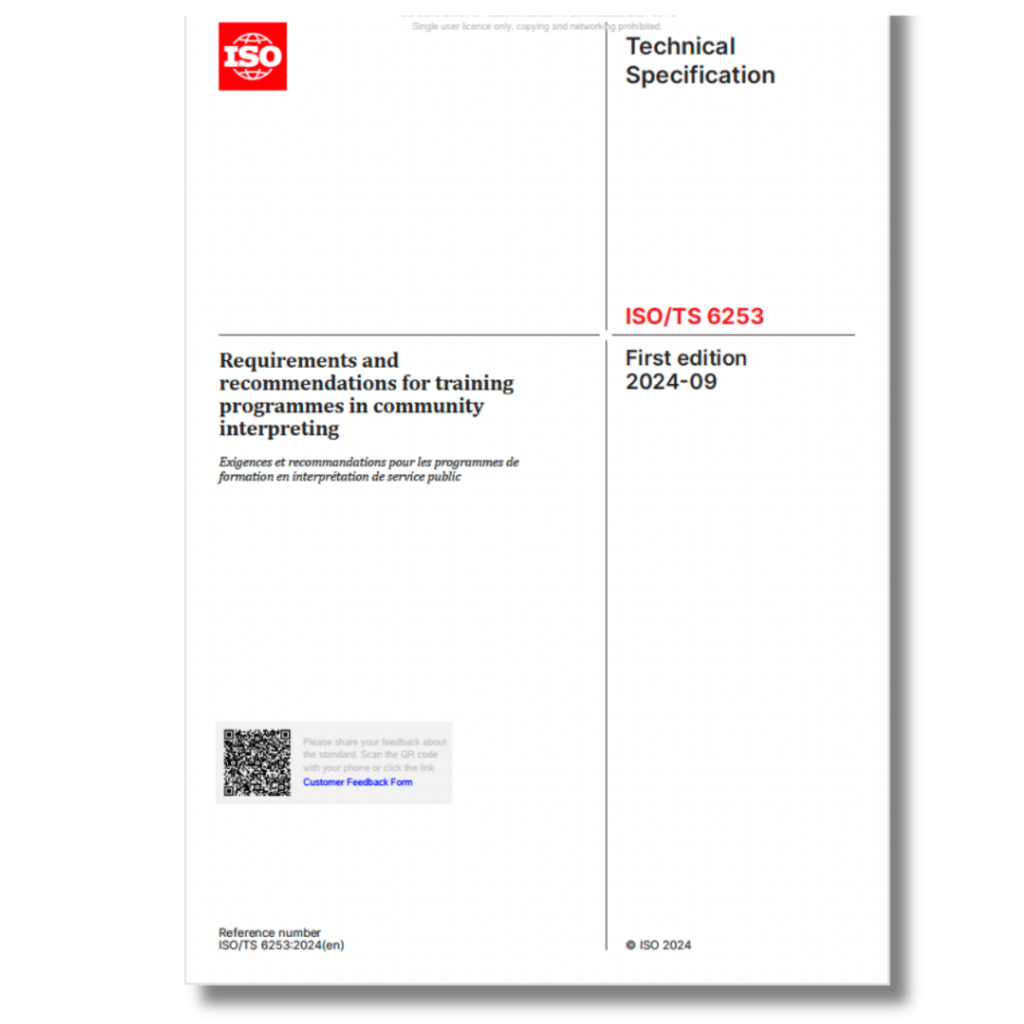
This gap between practice and formal pathways was a key impetus behind the development of ISO/TS 6253, an international standard designed to address training in community interpreting where traditional models fall short.
Specialization: Medical Interpreting and Court Interpreting
For many interpreters, foundational training is followed by specialization, and it is here that a critical distinction must be made. Specialization in interpreting is widely understood to mean subject-matter knowledge. Medical interpreters know medical terminology. Legal interpreters know legal terminology. This is accurate, but it is a significant understatement of what specialization actually requires.
To work credibly in a medical setting, an interpreter must understand more than vocabulary. They must understand the structure and hierarchy of a clinical environment, the dynamics of a patient-provider relationship, the ethical and legal framework governing patient confidentiality, working with multidisciplinary teams, and the weight of conversations about diagnosis, prognosis, and consent. They must know how to interpret these conversations not only accurately but appropriately, with an understanding of what is at stake for every person in the room.
The same depth applies in legal, mental health, educational, and other specialized contexts. In each setting, the interpreter is not simply a language conduit. They are a professional whose presence carries institutional weight. That credibility is not automatic. It is built through preparation, experience, and a sustained commitment to understanding the environments in which the work takes place.
The Professional Responsibility That Defines the Role
Interpreting is, at its core, a profession of consequence. A commitment to professionalism, including strict adherence to and understanding of completeness, fidelity to the message and accuracy can determine whether a patient receives the correct treatment, whether a defendant understands the charges they face, or whether a negotiation succeeds or fails. This is not the work of a background function. It is the work of a trained, accountable professional operating at the intersection of language, culture, and daily demands.
The weight of that responsibility is real. For the professionals who carry it well, it is also the most compelling reason they chose the field.
If you are considering this path, as a first career, a second, or a natural evolution of your language skills, the question is not whether the profession is demanding. It is whether the demand is something you are prepared to meet.
Begin by finding out where you stand. The Interpreters Lab Take the Do You Have What It Takes? Assessment
Sources for statistical information courtesy of Statistics Canada:
https://www12.statcan.gc.ca/census-recensement/2011/as-sa/98-314-x/98-314-x2011003_2-eng.cfm
https://www.canada.ca/en/immigration-refugees-citizenship/corporate/publications-manuals/departmental-plans/departmental-plan-2024-2025/departmental-plan-2024-2025-full.html