

The Real Game Remains Human-Centred – On Every Field of Play.
AI and Interpreting FIFA is giving us a very public example of something we are all trying to understand right now: technology can track the game, analyze the game, support decisions, and generate new ways of seeing what happened. But it does not play the game. The game is still played by the ...
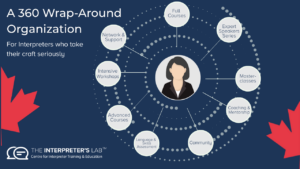
Interpreter Training Programs in Canada: From First Word to Full Career
A Learning Home Base for Interpreters at Every Stage of Their Career Interpreting is not a skill you learn once and carry forever. It’s a practice. It deepens with every encounter, every setting, every challenge that asks more of you than the last one did. The question isn’t whether to keep growing. It’s ...

The Interpreter’s Path: How to Enter One of Canada’s Most Essential Profession
Interpreting is everywhere. You encounter interpreters in hospitals, courtrooms, community centres, schools, at the insurance office, during financial aid meetings, or in child welfare visits, and even at the negotiating table when organizations or communities need to find common ground across a language divide. And yet, despite its reach and its stakes, the ...
Language is the door, not the destination.
Those of us who work in interpreting, whether we call it a field, a profession, or an industry, arrive here via many different pathways. In my observation, there are two common paths. Some come through language itself. They begin as translators, interpreters, linguists—people drawn to words, to structure, and to meaning, often working ...
Interpreter Training Is Not Content Delivery
Workshops, Techniques and the Hard Truth About Interpreter Training There are tips and techniques. There are workshops, webinars, and quick fixes. And then there is training. These things are not the same. Treating them as interchangeable has quietly undermined the interpreting profession for years. Workshops have value. They raise awareness, introduce ideas, and ...

Deep Impacts: 2025 Highlights at The Interpreter’s Lab
2025 was a year of deepening impact, strengthening training, advancing standards, and building stronger bridges between interpreters, institutions, and communities. At TIL, we continue to advocate at all levels for the important contributions of interpreters and for recognition of interpreting as a specialized profession. The work that we do and the initiatives supported ...
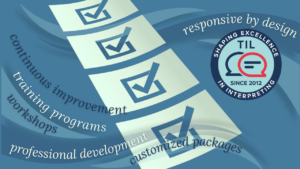
Interpreter Training That Keeps Pace
At The Interpreter’s Lab – Centre for Interpreter Education and Training (TIL), our programs are regularly reviewed and updated to reflect evolving professional standards, practitioner experience, and the realities of public-service interpreting. Continuous improvement is not an add-on, it is part of how we design, deliver, and assess training. What’s NEW for 2026 ...
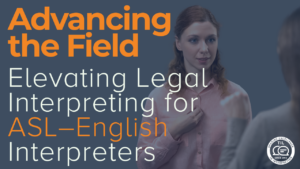
Advancing the Field: A Milestone in Court and Legal Interpreting for ASL-English Interpreters
We’re proud and delighted to share that The Interpreter’s Lab – Centre for Interpreter Education and Training has just completed the first-ever Interpreting in Legal and Court Settings: ASL–English Advanced Program, led by the exceptional Dr. Debra Russell. With over 20 ASL-English interpreters participating, this inaugural cohort marks a groundbreaking moment for interpreter ...

AI and Interpreting: What You Need to Know
This year at The Interpreter’s Lab, we’ve been digging deeper into AI, just as many others in the interpreting field have. Interpreting in community and public service settings, whether in education, healthcare, or law enforcement, is uniquely complex. It’s not only about managing dynamic, interpersonal communication but also about working across many languages ...

Raising the Standard: Language Access and the Role of Trained Healthcare Interpreters
Language access is a cornerstone of equity in healthcare: without it, care is not equally accessible, effective, or safe. For people who do not speak the same language as the service provider, or are Deaf or hard of hearing, access to trained interpreters is not just helpful — it’s essential for receiving safe, ...

Progress or Perish: In a World of Constant Change, Shouldn’t Education Keep Up?
Dr. Claudio Fantinuoli recently argued in an article for the Chartered Institute of Linguists that translation and interpreting education must evolve or risk becoming irrelevant—a point I’ve been making for years. While his focus is likely on conference interpreting curricula and simultaneous mode training, the same—or even greater—urgency applies to community and public-service ...

The Magnificent in the Ordinary
One morning, while out walking my pug – who, at fifteen, strolls through life on her own schedule – I came upon a beautiful arrangement of fallen flowers that someone had formed into a perfect heart on the ground. Instead of brushing them aside as dead waste, this lovely soul allowed them to ...

The Importance of Continuing Education for Interpreters
Learning Never Stops The Greek philosopher and historian Plutarch wrote “The mind is not a vessel to be filled, but a fire to be kindled.” Since Socrates, the notion that education should ignite curiosity and foster critical thinking—rather than merely promote rote memorization—has been a guiding principle. His philosophy emphasized questioning and dialogue ...
What’s in the Interpreter’s Toolbox?
From Skills to Impact: How We Help Interpreters Build Meaningful Careers At The Interpreter’s Lab, we design our courses with adults in mind – adults with busy schedules, other studies, family obligations, and those transitioning into or out of careers. Our courses are short and intensive, yet they cover all the essential principles ...
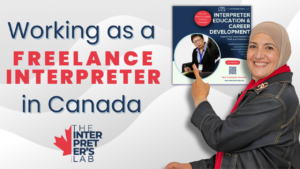
Interpreting in Health, Law Enforcement and Social Service Settings in Canada
Working as a freelance interpreter can be an exciting and fulfilling job. Interpreters help people from different language backgrounds communicate clearly with public service providers, ensuring everyone can access information and services accurately, privately, and fairly. Interpreters play a key role in today’s changing economy and community life by making sure everyone can ...
