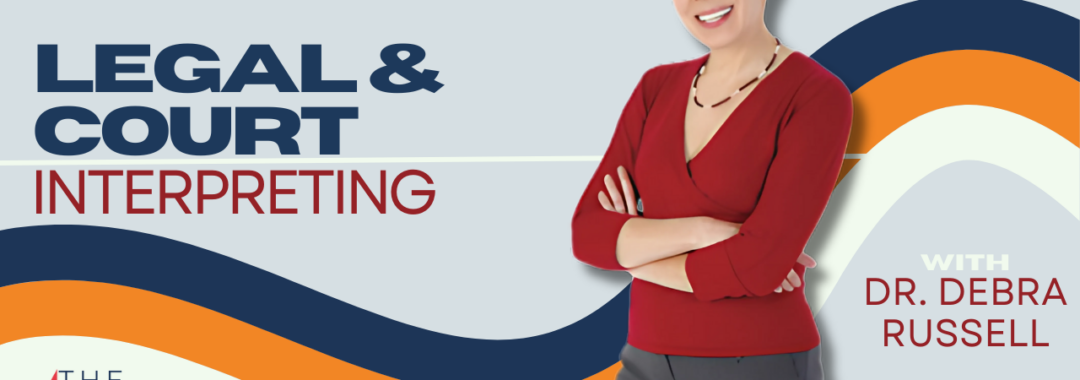
Advancing the Field: A Milestone in Court and Legal Interpreting for ASL-English Interpreters

We’re proud and delighted to share that The Interpreter’s Lab – Centre for Interpreter Education and Training has just completed the first-ever Interpreting in Legal and Court Settings: ASL–English Advanced Program, led by the exceptional Dr. Debra Russell. With over 20 ASL-English interpreters participating, this inaugural cohort marks a groundbreaking moment for interpreter education in BC and across Canada.

Advanced Training for ASL-English Interpreters in Court Settings

This program is more than another course, it represents the first coordinated, advanced training for interpreters in legal and court settings, built specifically for ASL-English interpreters and grounded in Canadian practice, standards, and legal frameworks. And it reflects something essential about how we work at The Interpreter’s Lab: when interpreters and our partners identify a gap, we respond, quickly, collaboratively, and with purpose.

After listening to ASL-English interpreters across BC describe the persistent gap in legal-interpreting training, we adapted our well-established spoken-language legal interpreter training framework and rebuilt it specifically for ASL-English interpreters. This required re-sequencing modules, reworking assignment design, and ensuring that the competencies, protocols, and ethical considerations unique to ASL–English court work were meaningfully integrated. And we did so in a relatively short time, ensuring that interpreters could access the training they needed without waiting years for a program to be developed.

Coordinated, advanced training for interpreters in legal and court settings, built specifically for ASL interpreters and grounded in Canadian practice, standards, and legal frameworks.

Under Dr. Russell’s leadership, participants engaged in rigorous, research-informed learning: case analyses, applied skill-development, explorations of courtroom dynamics, and considerations and protocols for team/co-interpreting practices. The energy, thoughtfulness, and commitment from this cohort made it clear just how needed, and overdue, this type of training truly is.

Best Practices, International Standards (ISO) and the Canadian Justice System

This program was also deliberately grounded in international standards and evidence-based research on interpreter education. Drawing on the ISO framework for interpreter training, particularly the standards developed under ISO TC 37/SC 5 and decades of scholarship on legal interpreting, assessment, and professional competencies, we ensured the curriculum aligned with recognized best practices.

Everything from sequencing to assignment design, to skill development was informed by research and premised on the Canadian Law and Justice system. This alignment with standards and evidence-based pedagogy is central to how we design our programs and reinforces our commitment to delivering training that reflects the realities and responsibilities of legal interpreting today.

“At The Interpreter’s Lab, our mission is to deliver accessible, responsive, and standards-based training”

We extend our sincere gratitude to all participants, and to Dr. Russell for her leadership, expertise, and generosity in shaping this pioneering program.

More Training Opportunities to Come in 2026

This inaugural cohort centred ASL–English interpreters; however, we acknowledge the important contributions of Deaf interpreters in legal settings and plan to explore future training options that support and reflect their role in this work. The timeline for this first delivery made it necessary to proceed with the established structure; however, The Interpreter’s Lab is fully prepared to adapt the program for a second offering that reflects the needs of all sign language interpreters.

“The information and the opportunity to have Dr Russell guide our learning was incredible, and I do feel as though it was a great professional development opportunity.”

As we continue investing in sector-specific ASL-English interpreter education, this first-of-its-kind program sets a new benchmark, and it’s only the beginning. More advanced training opportunities for signed-language interpreters are coming in 2026.

 

ILCS Banner

Interpreting in Legal & Court Settings Training Program

Advance Your Skills in Legal, Court, and Law-Enforcement Interpreting

This program provides the essential knowledge and practical skills needed to work confidently in legal, court, and related law-enforcement settings.

Recognized by the Ministry of Attorney General – Court Services Branch, the training strengthens your understanding of legal processes, terminology, protocols, and ethical responsibilities while preparing you for the CTTIC Court Interpreter certification exam.

What You’ll Learn:

  • Key procedures and protocols across legal, court, and law-enforcement environments
  • Legal terminology, research strategies, and resource navigation
  • Sight translation, memory, conversion, and note-taking techniques
  • Consecutive and simultaneous interpreting practice
  • Professional ethics and standards of conduct

Program Includes

  • Live online classes with interactive role plays and simulations
  • Curated resources and links

Plus Two student manuals:

  • Interpreting in Legal and Court Settings
  • Glossary & Terminology Workbook

Optional bilingual tutorials (e.g., Building Your Bilingual Legal Glossary)

Develop the competence, clarity, and confidence needed to interpret effectively across legal and court environments.

Find out more: www.interpreterslab.org/programs-court-interpreter-training

Have questions before you join? Sign up for a FREE INFORMATION SESSION  and get all your questions answered before you sign up.

2025 Annual Masterclass Interpreting in Law Enforcement Settings with Dr. Debra Russell

About the 2025 Masterclass

Interpreting in Law Enforcement Settings with Dr. Debra Russell

This Masterclass will centre on best practices for interpreters working with law enforcement agencies, with a particular focus on interpreting for the police.

It is designed to teach interpreters the practical skills and knowledge required to work effectively in police settings while understanding the Canadian legal context.

Workshop Overview

This specialized Masterclass is designed for interpreters working in legal, court and community settings who want to deepen their skills in law enforcement interpreting. With a focus on real-world application, participants will engage in hands-on activities using police transcripts and case studies.

Led by Dr. Debra Russell, this interactive session includes role-play exercises that will challenge and refine participants’ ability to accurately interpret complex, emotionally charged, and sensitive communications between civilians and law enforcement personnel. Ethical dilemmas, professional boundaries, and the consequences of interpreter errors will also be explored, equipping interpreters with practical strategies to manage dynamic situations.

Participants will leave the workshop with a greater understanding of the protocols, expectations, and pressures unique to interpreting in policing contexts—and the confidence to perform their roles with accuracy and professionalism.

Participants will learn to:

  • Be better prepared to handle the demands of interpreting in law enforcement settings.
  • Communicate effectively with police personnel and navigate law enforcement structures.
  • Address ethical dilemmas with clarity and confidence.
  • Apply interpreting strategies that uphold standards in legal contexts.
  • Understand the real-world consequences of interpreter errors—and how to avoid them.
  • Reflect on personal positioning and neutrality in adversarial or emotionally intense environments.

Pricing

TIL Members: $25 + GST

Non-members: $85 + GST

PDU’s/ CEU’s: 3 (CTTIC & Partners)

Master Legal Interpreting with Dr. Debra Russell

Your Path to Interpreting in Legal & Court Settings

Legal interpreting involves facilitating communication in a range of proceedings — depositions, trials, hearings, and more. It demands not only fluency in multiple languages but also a deep understanding of legal terminology, procedures, and cultural nuances that can influence communication.

Who Should Take This Course

If you have been working as an interpreter in other settings, such as social services, financial assistance, and other community-based situations, but are now ready to expand your practice, interpreting in legal and court settings is for you.

“It was a well-structured course led by a very knowledgeable instructor. I highly recommend this course to any interpreter who might be interested in interpreting in legal and court settings.”

– Corina, Interpreting in Legal and Court Settings Student / TIL

This course is designed for busy professionals who already have a lot going on but want to gain the skills and knowledge to expand their interpreting practice. Working as a court interpreter frequently means a higher hourly rate, with standard minimum hours per assignment.

With these additional specialized skills, you will be able to command higher pay rates—beyond courts and tribunals—that reflect the value you bring to all high-stakes, law enforcement environments.

Career Opportunities for Legal Interpreters

Qualified legal interpreters work with: 

  • Law firms 
  • Courts at all levels (local, provincial, and federal) 
  • Administrative tribunals 
  • Examinations for discovery and other legal settings 
  • Immigration and Refugee Board 
  • Municipal Police and the RCMP

The Ministry of the Attorney General, Court Services Branch (CSB), recognizes The Interpreter’s Lab (TIL) training as a qualification for court interpreting. Our Interpreting in Legal and Court Settings program is listed on the CSB spoken language interpreter application form, reflecting the quality and relevance of our training for interpreters pursuing work in legal environments.

Why Specialized Training in Legal and Court Interpreting Is Essential

Who better to teach legal and court interpreting than such an esteemed interpreter and educator as Dr. Debra Russell?

Meet Your Instructor Dr. Debra Russell

Dr. Debra Russell, a Canadian-certified interpreter, educator, and researcher with over 30 years of experience, has been at the forefront of advancing legal interpreting practices. She is a highly regarded educator and returns to TIL to lead our Interpreting in Legal and Court Settings program, starting February 6, 2025. This is a unique opportunity to learn from one of Canada’s most respected educators in the field.

Dr. Russell emphasizes the need for specialized skills to excel in legal and court settings, sharing insights into the complexities of working in these formal and high-stakes environments. Sharing her perspective as someone whose work and research have been rooted in the legal interpreting field for decades, Dr. Russell states:

“Legal proceedings are complex and nuanced. Misunderstandings in these settings can have serious consequences. Training provides interpreters with the skills and knowledge to navigate these challenges confidently and effectively.”

Specialized training prepares interpreters to handle the demands of legal proceedings by building on their existing expertise and addressing areas like:

  • Mastering legal terminology 
  • Becoming aware of and comfortable with procedural protocols 
  • Understanding the communication dynamics that influence interpreting in legal settings 
  • Gaining confidence to work in courtrooms, tribunals, or administrative hearings 
  • Understanding how to work in a variety of law enforcement settings (e.g., municipal police, RCMP, Canadian Border Services Agency)

This training helps interpreters navigate intimidating legal environments with professionalism, reducing anxiety and ensuring accuracy.

Take Your Career to the Next Level – Recognized by Agencies and Professional Memberships Across Canada including the Ministry of the Attorney General (MAG) 

If you’re an interpreter looking to expand your skill set and explore new opportunities, consider enrolling in TIL’s Interpreting in Legal and Court Settings program. By investing in this training, you’ll gain the tools needed to excel in legal settings and stand out as a professional in the field. 

This is also your chance to learn directly from Dr. Russell, whose expertise, research, and passion for teaching make her an invaluable resource for interpreters at all stages of their careers.

Start your journey toward becoming a highly skilled legal interpreter and open the door to a rewarding and  meaningful career.


Next Program Start Date: February 6, 2025

REGISTRATION CLOSES ON JANUARY 31, 2025

Live Sessions run Thursdays: 5:30 p.m. to 7:30 p.m. PST (UTC-7)

This course is a blended learning program, combining both online, real-time instruction with self-guided content, materials, resources, and student manuals.

  • TIL Members receive 20% off all second-level, advanced courses.

Learn More OR Register See the Course Outline