The Real Game Remains Human-Centred – On Every Field of Play.

AI and Interpreting

FIFA is giving us a very public example of something we are all trying to understand right now: technology can track the game, analyze the game, support decisions, and generate new ways of seeing what happened. But it does not play the game. The game is still played by the players.

At the highest levels of sport, technology is everywhere: data, analytics, video review, player tracking, semi-automated offside technology, and AI-supported match analysis. These tools are powerful, and they are changing how the game is assessed, prepared for, and understood. But they do not replace the players. The game itself remains human. The skill belongs to the players. At the most fundamental level, what matters most is still human: focus, discipline, timing, trust, judgment, communication, and the ability to respond to what is happening in the moment.

The real work, the real game, and the real commitment remain human-centred.

Mobilizing the Real Benefits of AI

Communication is the primary function of an interpreter. It is not just the words that matter, but the interactive, evolving, interpersonal engagement between human beings expressing intent, motivation, needs, questions, uncertainty, and meaning; and then receiving and processing all of that in real time.

Interpreting in community settings, healthcare, justice, financial assistance, education, and other public service spaces, is more than moving words across languages. It is about the connection that happens in these spaces, and the efficiency and effectiveness of that connection.

AI is changing the way we work. And that is a good thing. It can support communication, improve coordination, assist with preparation, and help organizations think differently about access. But it does not replace the human responsibility at the centre of the work. AI can support the work. It can analyze the work. It can represent the work. But it is not the work.

The Human Work of Interpreting is Not Pattern Matching.

Interpreting is not simply the transfer of words. It requires judgment, ethics, context, cultural understanding, professional boundaries, and real people making real decisions in moments that matter. It is a form of intelligence that AI has not yet replicated.

AI functions through pattern recognition; interpreting requires thinking. It is a cognitive process that involves analyzing information, intention, context, meaning, and content in real time. Interpreting is not pattern-matching. It is human judgment in motion.

As Sangeet Paul Choudary writes in Reshuffle, AI’s “approach to reasoning, by predicting the next likely word from countless possibilities, is nothing like how humans use language” [1].

AI does not think in the human sense. It processes language by recognizing patterns, structures, and probabilities in large bodies of text. What makes contemporary AI powerful is not human understanding, but its ability to filter, rank, and foreground certain information as most relevant in each context. In that sense, AI does not simply respond to us; it also shapes what is brought forward for our attention. This is why human judgment remains essential: people must still ask what has been emphasized, what has been left out, and whether the response reflects meaning, intention, context, and consequence [2].

Interpreters Think. Think About That.

As we watch players perform with extraordinary focus and commitment, we are reminded that excellence is never only technical. It is human. The AI-generated replays on the screen are useful, but they are still only a representation of the game. They are not the game itself.

At The Interpreter’s Lab, we continue to believe in using new tools wisely, while keeping people at the centre of this very important work.

AI-assisted, yes.

Human-centred, always.
___________________________

[1] Sangeet Paul Choudary, Reshuffle: Who Wins When AI Restacks the Knowledge Economy (2025). p. 13

[2] Sangeet Paul Choudary, Reshuffle: Who Wins When AI Restacks the Knowledge Economy (2025)

Reference

Choudary, Sangeet Paul. Reshuffle: Who Wins When AI Restacks the Knowledge Economy. Sangeet Paul Choudary, 2025.

Master Legal Interpreting with Dr. Debra Russell

Your Path to Interpreting in Legal & Court Settings

Legal interpreting involves facilitating communication in a range of proceedings — depositions, trials, hearings, and more. It demands not only fluency in multiple languages but also a deep understanding of legal terminology, procedures, and cultural nuances that can influence communication.

Who Should Take This Course

If you have been working as an interpreter in other settings, such as social services, financial assistance, and other community-based situations, but are now ready to expand your practice, interpreting in legal and court settings is for you.

“It was a well-structured course led by a very knowledgeable instructor. I highly recommend this course to any interpreter who might be interested in interpreting in legal and court settings.”

– Corina, Interpreting in Legal and Court Settings Student / TIL

This course is designed for busy professionals who already have a lot going on but want to gain the skills and knowledge to expand their interpreting practice. Working as a court interpreter frequently means a higher hourly rate, with standard minimum hours per assignment.

With these additional specialized skills, you will be able to command higher pay rates—beyond courts and tribunals—that reflect the value you bring to all high-stakes, law enforcement environments.

Career Opportunities for Legal Interpreters

Qualified legal interpreters work with: 

  • Law firms 
  • Courts at all levels (local, provincial, and federal) 
  • Administrative tribunals 
  • Examinations for discovery and other legal settings 
  • Immigration and Refugee Board 
  • Municipal Police and the RCMP

The Ministry of the Attorney General, Court Services Branch (CSB), recognizes The Interpreter’s Lab (TIL) training as a qualification for court interpreting. Our Interpreting in Legal and Court Settings program is listed on the CSB spoken language interpreter application form, reflecting the quality and relevance of our training for interpreters pursuing work in legal environments.

Why Specialized Training in Legal and Court Interpreting Is Essential

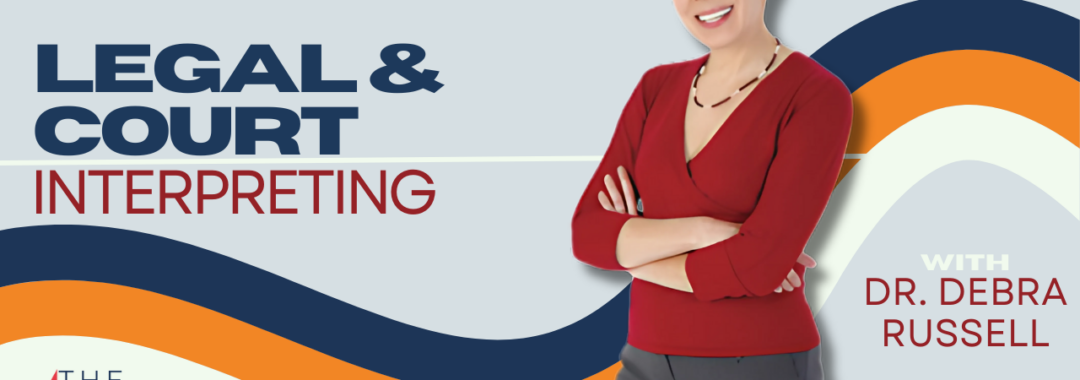
Who better to teach legal and court interpreting than such an esteemed interpreter and educator as Dr. Debra Russell?

Meet Your Instructor Dr. Debra Russell

Dr. Debra Russell, a Canadian-certified interpreter, educator, and researcher with over 30 years of experience, has been at the forefront of advancing legal interpreting practices. She is a highly regarded educator and returns to TIL to lead our Interpreting in Legal and Court Settings program, starting February 6, 2025. This is a unique opportunity to learn from one of Canada’s most respected educators in the field.

Dr. Russell emphasizes the need for specialized skills to excel in legal and court settings, sharing insights into the complexities of working in these formal and high-stakes environments. Sharing her perspective as someone whose work and research have been rooted in the legal interpreting field for decades, Dr. Russell states:

“Legal proceedings are complex and nuanced. Misunderstandings in these settings can have serious consequences. Training provides interpreters with the skills and knowledge to navigate these challenges confidently and effectively.”

Specialized training prepares interpreters to handle the demands of legal proceedings by building on their existing expertise and addressing areas like:

  • Mastering legal terminology 
  • Becoming aware of and comfortable with procedural protocols 
  • Understanding the communication dynamics that influence interpreting in legal settings 
  • Gaining confidence to work in courtrooms, tribunals, or administrative hearings 
  • Understanding how to work in a variety of law enforcement settings (e.g., municipal police, RCMP, Canadian Border Services Agency)

This training helps interpreters navigate intimidating legal environments with professionalism, reducing anxiety and ensuring accuracy.

Take Your Career to the Next Level – Recognized by Agencies and Professional Memberships Across Canada including the Ministry of the Attorney General (MAG) 

If you’re an interpreter looking to expand your skill set and explore new opportunities, consider enrolling in TIL’s Interpreting in Legal and Court Settings program. By investing in this training, you’ll gain the tools needed to excel in legal settings and stand out as a professional in the field. 

This is also your chance to learn directly from Dr. Russell, whose expertise, research, and passion for teaching make her an invaluable resource for interpreters at all stages of their careers.

Start your journey toward becoming a highly skilled legal interpreter and open the door to a rewarding and  meaningful career.


Next Program Start Date: February 6, 2025

REGISTRATION CLOSES ON JANUARY 31, 2025

Live Sessions run Thursdays: 5:30 p.m. to 7:30 p.m. PST (UTC-7)

This course is a blended learning program, combining both online, real-time instruction with self-guided content, materials, resources, and student manuals.

  • TIL Members receive 20% off all second-level, advanced courses.

Learn More OR Register See the Course Outline