At The Interpreter’s Lab – Centre for Interpreter Education and Training (TIL), our programs are regularly reviewed and updated to reflect evolving professional standards, practitioner experience, and the realities of public-service interpreting. Continuous improvement is not an add-on, it is part of how we design, deliver, and assess training.
What’s NEW for 2026
- Updated ethical guidelines, standards of practice, and competency frameworks, aligned with current international standards
- Improved navigation to help participants move more easily through course content
- Enhanced learning resources to support applied practice
- Course content updated to ensure alignment with current standards, clearer competency expectations, and consistent assessment of learning outcomes.
Professional Standards
Professional standards are not static. ISO standards, for example, are developed by international experts and are periodically reviewed and revised to remain relevant as professional contexts, technologies, and expectations evolve. As a long-standing member of ISO TC 37/SC 5 (since 2010) and the Project Leader for ISO/TS 6253:2024 – Requirements and Recommendations for Training Programmes in Community Interpreting, TIL’s Founder and Director, Angela Sasso, is very familiar with the components required to prepare bilingual individuals to work competently as interpreters in public-service settings.
This expertise, combined with the exceptional experience of our instructional team, all practicing interpreters, translators and educators, underpins TIL’s approach. Ethical decision-making, standards of practice, and clearly defined competencies form the foundation of our course design, and recent updates to international guidance are reflected throughout our curriculum.
Our programs follow the newest international standard, ISO TS 6253:2024, which sets the requirements and recommendations for interpreter training in community settings. We are also active across Canada in training interpreters, working with organizations, and supporting educators.
Because there is no outside accreditation body for this standard, we created our own careful review process. This process is based on our long history with standards work since 2010 and more than 30 years of experience in the interpreting field.
Assessment and Certification
All TIL courses conclude with a final exam to assess learning outcomes. Assessment is an essential part of ensuring that participants have not only attended but have met the learning objectives. To be awarded a Certificate of Successful Completion, participants must:
- Achieve a minimum 75% passing grade on the final exam
- Attend live, instructor-led sessions
- Complete all online modules and assignments
Participants who complete the live sessions but do not meet all assessment requirements may instead receive a Confirmation of Attendance, verifying their participation.
Investing in credible, standards-based training is not about adding barriers; it is about building a more reliable, sustainable interpreting workforce that organizations and consumers can confidently rely on.
Balancing Access and Professional Expectations
At TIL, we work deliberately to balance accessible learning with professional rigour. This balance is not always simple, but it is essential if training is to be both inclusive and credible for the organizations and communities interpreters serve.
Our programs are designed to be accessible at the outset, with flexibility to expand into more in-depth, customized learning over time when organizational or workforce needs call for it.
Looking Ahead to 2026 and Beyond
In 2025, we also delivered advanced training in legal and court settings for ASL–English interpreters in British Columbia. Building on that work, this program will be offered nationally in 2026, further strengthening specialized training pathways across Canada.
What This Means for Agencies and Organizations
For agencies and organizations responsible for procuring, managing, and assuring the quality of interpreting services, training is not simply a credential, it is a risk-management and workforce-development tool.
Standards-aligned training helps ensure that interpreters understand and apply ethical decision-making, professional boundaries, role clarity, and sector-specific protocols consistently across assignments. This reduces variability in service delivery, supports compliance with institutional policies, and strengthens confidence among service users, staff, and funders.
TIL’s approach supports quality assurance by:
- Delivering training through a live, instructor-led and blended format, and never fully asynchronous learning
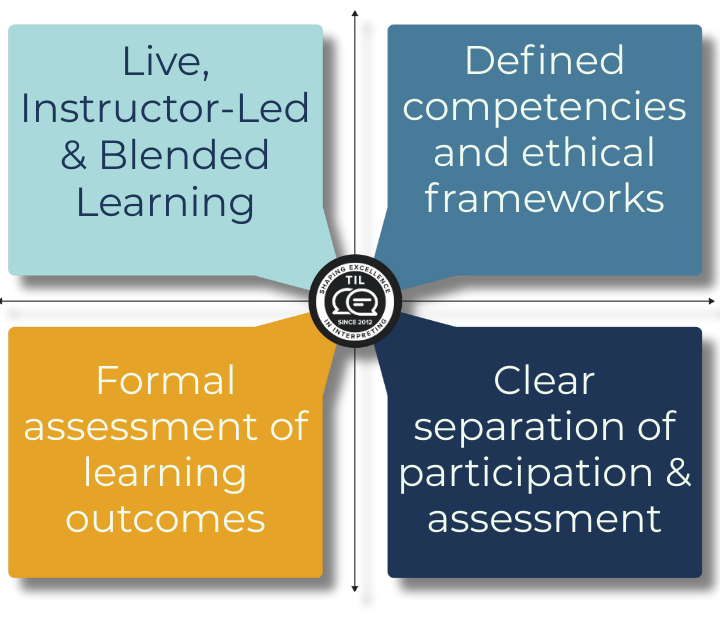
- Embedding clearly defined competencies and ethical frameworks into all training
- Assessing learning outcomes through formal evaluation, not attendance alone
- Providing transparent distinctions between completion, assessment, and participation
From a procurement and contracting perspective, standardized training benchmarks make it easier to articulate expectations, compare qualifications, and demonstrate due diligence when responding to audits, complaints, or funding requirements.
From a workforce-development standpoint, structured training pathways support interpreter retention, professional growth, and readiness for increasingly complex public-service environments. Agencies benefit from interpreters who are better prepared, more consistent in practice, and clearer about professional limits, reducing downstream issues and supervisory burden.
In short, investing in credible, standards-based training is not about adding barriers; it is about building a more reliable, sustainable interpreting workforce that organizations and consumers can confidently rely on.
- If you are interested in receiving a copy of our updated Code of Conduct or Competencies Framework, please contact us at admin@interpreterslab.org