
Deep Impacts: 2025 Highlights at The Interpreter’s Lab

2025 was a year of deepening impact, strengthening training, advancing standards, and building stronger bridges between interpreters, institutions, and communities.

At TIL, we continue to advocate at all levels for the important contributions of interpreters and for recognition of interpreting as a specialized profession. The work that we do and the initiatives supported interpreters across spoken and signed languages nationwide. In 2025 over 150 new and practicing interpreters engaged in our training and continuing education programs. Building on current research and established best practices endorsed by international experts, TIL regularly strengthens its core curriculum and foundational ethical guidelines for interpreters.

Check out this Blog for More Information on How TIL Sets the Pace

Programs continued to align with Canadian and international standards while remaining grounded in real-world practice.

Learning & Professional Development (Membership Program)

Professional Development and Continuing Education

Interpreting in Law Enforcement – Working with the Police – Masterclass with Dr. Debra Russell (offered again in 2026)

  • 2 sessions for ASL interpreters
  • 1 session for spoken-language interpreters

Four cohorts of Interpreting in Community Settings – A Foundational Program

Interpreting in Legal & Court Settings

  • 1 cohort for spoken-language interpreters
  • 1 cohort for ASL–English interpreters, adapted from our long-standing spoken-language curriculum to meet the specific requirements of ASL–English interpreting.

Program & Curriculum Development

  • Implemented ISO/TS 6253:2024 across programs, supported by a successful full internal audit.

Updated course content across programs, including:

  • Revised Ethical Guidelines for Interpreters in Community Settings
  • Updated competency frameworks and assessment measures
  • Engaged a new instructor with expertise in training for interpreting in Indigenous languages 

Partnerships & Customized Training

  • Designed and delivered a customized training program for the Family Support Institute of BC (Resource Parent / Peer Programs)
  • Welcomed new partner agencies into our organizational training programs
  • Strengthened collaboration with professional membership organizations in Canada and internationally

Sector Leadership & Standards

Continued service as:

  • Board Member and Chair, Interpreting Committee – Canadian Language Industry Association (CLIA)
  • Certified Member, Women Business Enterprises (WBE)
  • Presentation to Canadian Translators, Terminologist and Interpreters Council Board at their annual AGM on ISO TC 37/SC 5 projects and standards
  • Ongoing leadership in the rollout and implementation of international standards in interpreter education
  • Initiated the BC Working Group on Interpreting Services, in collaboration with the Provincial Language Service (PHSA BC), a cross-sectoral initiative exploring system-level improvements to access and information on qualified language services.

Presentations & Advocacy

  • Speech-Hearing BC: Enhancing Speech-Language Pathology Practices: Strategies for Effective Collaboration with Interpreters
  • Health Standards Organization (HSO): Language Access as the Tipping Point for Equity and Inclusion
  • PSIT Networking Group – UK – London Metropolitan University (June 13); The Canadian Experience in Public Service Interpreting
  • Met with Minister Niki Sharma, BC Attorney General, to discuss language access, interpreting, procurement practices, and ISO standards.

Media & Knowledge Sharing

Excellence as Standard Practice

2025 was an exceptional year for The Interpreter’s Lab, marked by meaningful growth, collaboration, and impact. As always, we continue to evolve our programs, strengthen standards-aligned training, and respond to emerging needs in the field.

This progress is only possible through the trust and engagement of our members, partners, and collaborators. We look forward to building on this momentum together in 2026.
Interpreting in Health, Law Enforcement and Social Service Settings in Canada

Working as a freelance interpreter can be an exciting and fulfilling job. Interpreters help people from different language backgrounds communicate clearly with public service providers, ensuring everyone can access information and services accurately, privately, and fairly.

Interpreters play a key role in today’s changing economy and community life by making sure everyone can fairly access essential services like healthcare, legal support, education, and social services. They help service providers and clients communicate effectively when needed. This task requires critical thinking skills and core competencies necessary to perform the work correctly. 

Role and Skills of Interpreters in Community Based Settings

Interpreters work in many different environments, making it hard to list all the places they might be needed. In a diverse country like Canada, interpreters play a key role in almost every part of community life, helping people communicate while respecting language differences. Their work helps keep communities connected and inclusive.

Being an interpreter requires a range of important skills. While many assume language ability is the main requirement, it’s just one of many. Interpreters need to be strong communicators with excellent interpersonal and intercultural awareness. They should have sharp cognitive abilities, a desire to improve memory, multitasking skills, and strong organizational habits. Beyond these, interpreters learn specialized techniques such as note-taking, consecutive and simultaneous interpreting, sight translation, research skills, and more.

Becoming a Freelance Interpreter

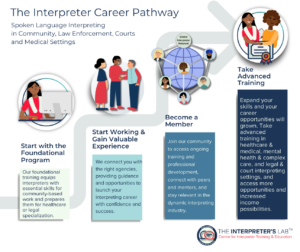
Training

Starting a new career begins with getting the right training. Interpreting, like any other profession, requires key skills and knowledge. A foundational training program will prepare you to work confidently as an interpreter. It’s about more than just knowing two languages – interpreters need specialized skills to work effectively with professionals like lawyers, doctors, nurses, and social workers.

Practice

Start working as an interpreter to sharpen your skills. Real-world experience will give you valuable insights into the profession. You’ll learn to handle different personalities, manage your schedule, plan your days, and research terms or office procedures before appointments. These hands-on experiences are part of the job. As you go, you might discover the need for new skills or a network of peers to help you navigate challenges. Interpreting is a practical profession where much of the learning happens on the job, as you apply what you’ve learned in training.


Continuing Education and Up-Skilling

It’s important to keep your skills up to date. Interpreters should attend regular workshops and professional development sessions. Be sure to keep records of your training by collecting certificates of attendance or participation. Ongoing education helps show your commitment and skill level.

You might also choose to specialize in areas like medical or legal interpreting. To expand your practice, consider taking specialized training programs. (Check out our article on why specialized training matters here – link the blog.) Working in specialized fields such as healthcare, law enforcement, and education involves more than just learning new terms. It requires understanding the systems, the professionals working in them, and their protocols, procedures, and processes.

Assessments and Certification

Consider taking a skills assessment to verify both your language abilities and professional interpreting skills. The CILISAT, recognized across Canada, is a one-time test that, if passed, provides a certificate confirming your qualifications in community interpreting. The Interpreter’s Lab is an authorized testing centre for the CILISAT. You can find out more HERE.

If you’re interested in becoming a certified interpreter, Canada offers three certification options, each with its own testing process. Certification requires maintaining professional membership and paying annual dues. You can learn more about the certification process by reading our blog on Interpreter Certification in Canada

Networking 

Join professional associations and membership groups to network and grow your career. Connect with peers, meet industry representatives, attend conferences and forums, and explore volunteer opportunities. These experiences can introduce you to new practice areas and ways of working while expanding your professional connections.

The Interpreter’s Lab Membership Program is a great start. Meet other interpreters, join the Community Hub, and get perks on training and professional development. 

Income and Career Outlook

Freelance interpreters working in community and public sector services like healthcare, social services, immigration, or courts typically earn between $26 and $70 per hour. This range varies across organizations and settings, and is different across Canada.

A key benefit of freelance interpreting is the ability to create your own schedule. Assignments can be during the day, evenings, or weekends, and may involve working in person, by phone, or on video calls. Interpreters often work with multiple agencies, allowing them to choose assignments and build strong professional relationships as they advance in their careers.

Working as a freelance community and healthcare interpreter in Canada can be a fulfilling career that blends language skills, cultural competence, and public service.

With the right certifications, ongoing skill development, and strategic networking, interpreters can build a successful freelance career while making a positive impact in their communities.]

FIND OUT MORE AT www.interpreterslab.org  OR JOIN AN INFORMATION SESSION AND GET YOUR QUESTIONS ANSWERED ON THE SPOT